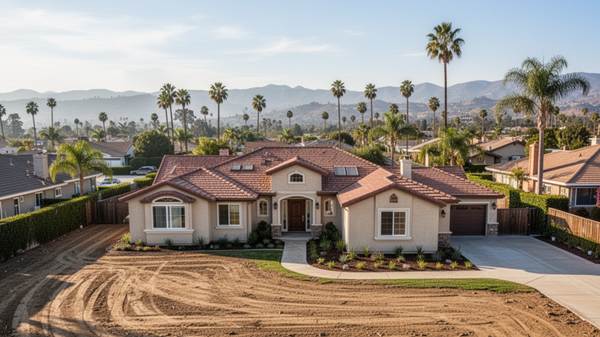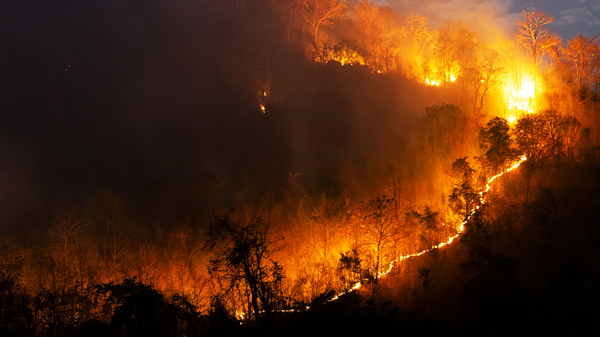
Meet the New Defensible Space Score: A Free Check of the Ground around Your Home
We rebuilt Defensible Space Score from the ground up. Here is what defensible space is, where California's Zone 0 rules stand and what your free score checks.
We rebuilt Defensible Space Score from the ground up. If you checked your property with us before, your old score came from the earlier version, so it is worth a fresh look. If you are new here, this post covers what the tool is, what defensible space means under California law, where the new Zone 0 rules stand, and what your score does and does not tell you.
What Defensible Space Score Is
Defensible Space Score is a free self-assessment of the ground around your house, from the walls out to 100 feet. You answer fourteen plain-language questions about vegetation, spacing and the first five feet against your walls. It takes about five minutes, with no account, and at no cost to you.
It is built for homeowners in California's wildfire country who want to know where their yard stands before fire season, and what to work on first. While the measures come from California's defensible space guidance, they are applicable to any property in a wildfire risk zone.
What Defensible Space Is
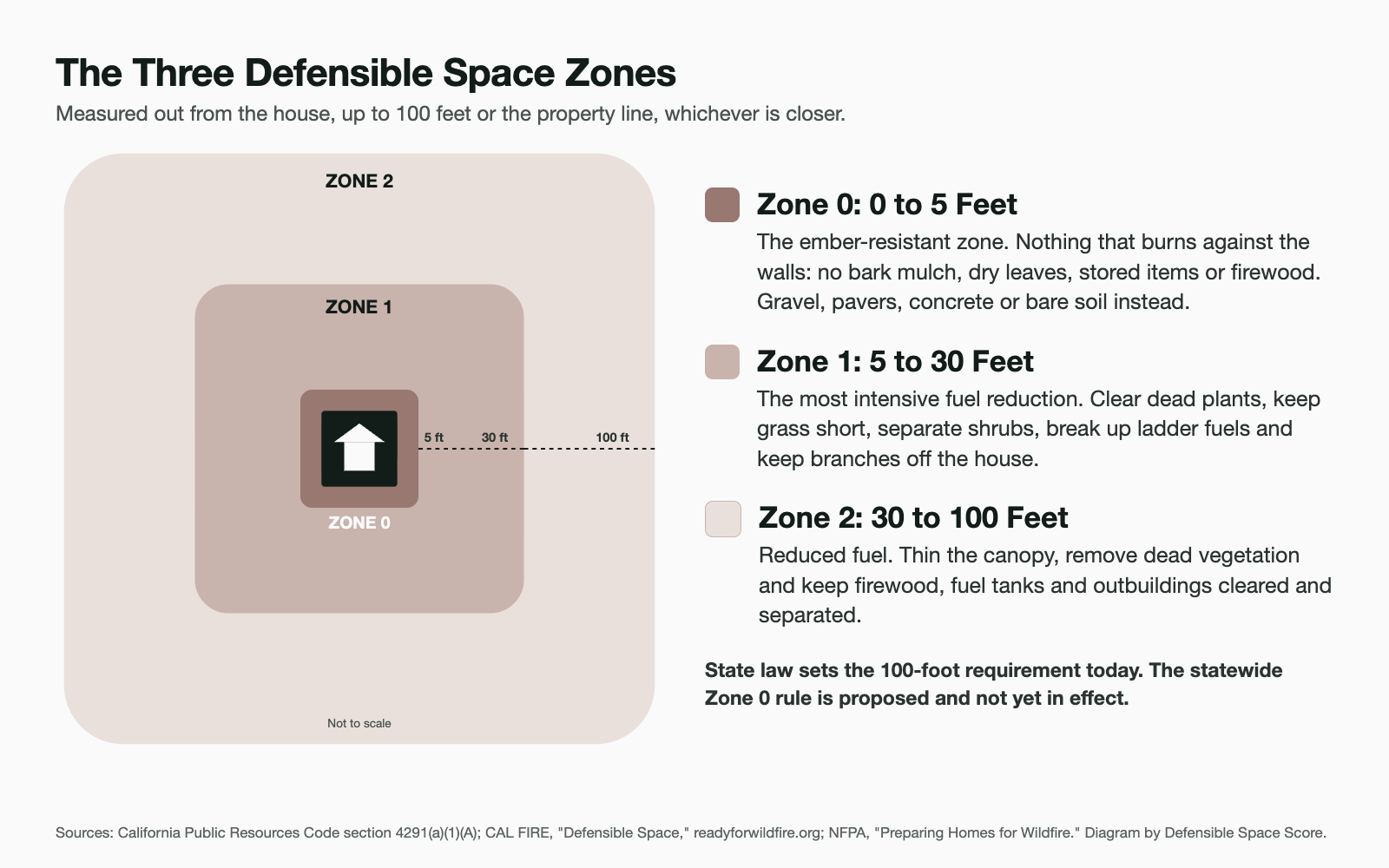
Defensible space is the managed area around a home where vegetation and other fuel are kept in a condition that slows an approaching fire and gives firefighters room to work. California's Public Resources Code section 4291 requires anyone who owns or maintains a structure in a State Responsibility Area to keep defensible space of 100 feet from each side of the structure, but not beyond the property line. A parallel law covers Very High Fire Hazard Severity Zones managed by local agencies.
The statute lets the intensity of fuel management vary across those 100 feet, with more intense fuel reduction between 5 and 30 feet, and an ember-resistant zone within 5 feet once the state Board of Forestry and Fire Protection writes the rules for it.
The Three Zones: What to Do and What Your Score Checks
CAL FIRE divides those 100 feet into three zones, and the National Fire Protection Association's home ignition zone uses the same distances. NFPA's Preparing Homes for Wildfire page is a good companion guide. Here is what each zone asks of you, and what your score checks there.
Zone 0: 0 to 5 Feet
The ember-resistant zone. Embers land and collect against the walls, so keep anything that burns off the ground there. Swap bark mulch for gravel, pavers or concrete, and move stored items and firewood away.
Your score checks: combustible material cleared, noncombustible groundcover, and nothing stored against the house.
Zone 1: 5 to 30 Feet
The most intensive fuel reduction. Clear dead plants and leaves, keep grass short, separate shrubs into groups, remove ladder fuels (plants that let a ground fire climb into trees), and trim branches back from the house and roof.
Your score checks: ladder fuels removed, grass kept short, shrubs spaced rather than continuous, lower tree limbs cleared, and vegetation not touching the house.
Zone 2: 30 to 100 Feet
Reduced fuel. Thin crowded trees and shrubs, remove dead vegetation, and repeat the cleanup every season.
Your score checks: canopy thinned, dead vegetation removed, and upkeep done every season.
Perimeter and Access
The score adds a fourth group for fire engine access and anything stored or built away from the house. Keep the driveway clear, store firewood and fuel tanks well away from the house, and clear around sheds.
Your score checks: a driveway clear for a fire engine, firewood and fuel stored away from the house, and outbuildings cleared and separated.
Every question includes a "Not sure" option. It is left out of the calculation and does not lower your score; it shows up as an open item to go check. Four measures act as gates. They can hold your score's label back until they are met, but they never subtract points.
Defensible space is mostly maintenance. Grass grows back, leaves fall, and a clean yard in April can be a problem by August. A quick seasonal walk around the house does more than one big cleanup.
The Rise of Zone 0 Rules
For years, the first five feet were a recommendation. That is changing, first at the city level and, if the state finalizes its rules, statewide.
Berkeley
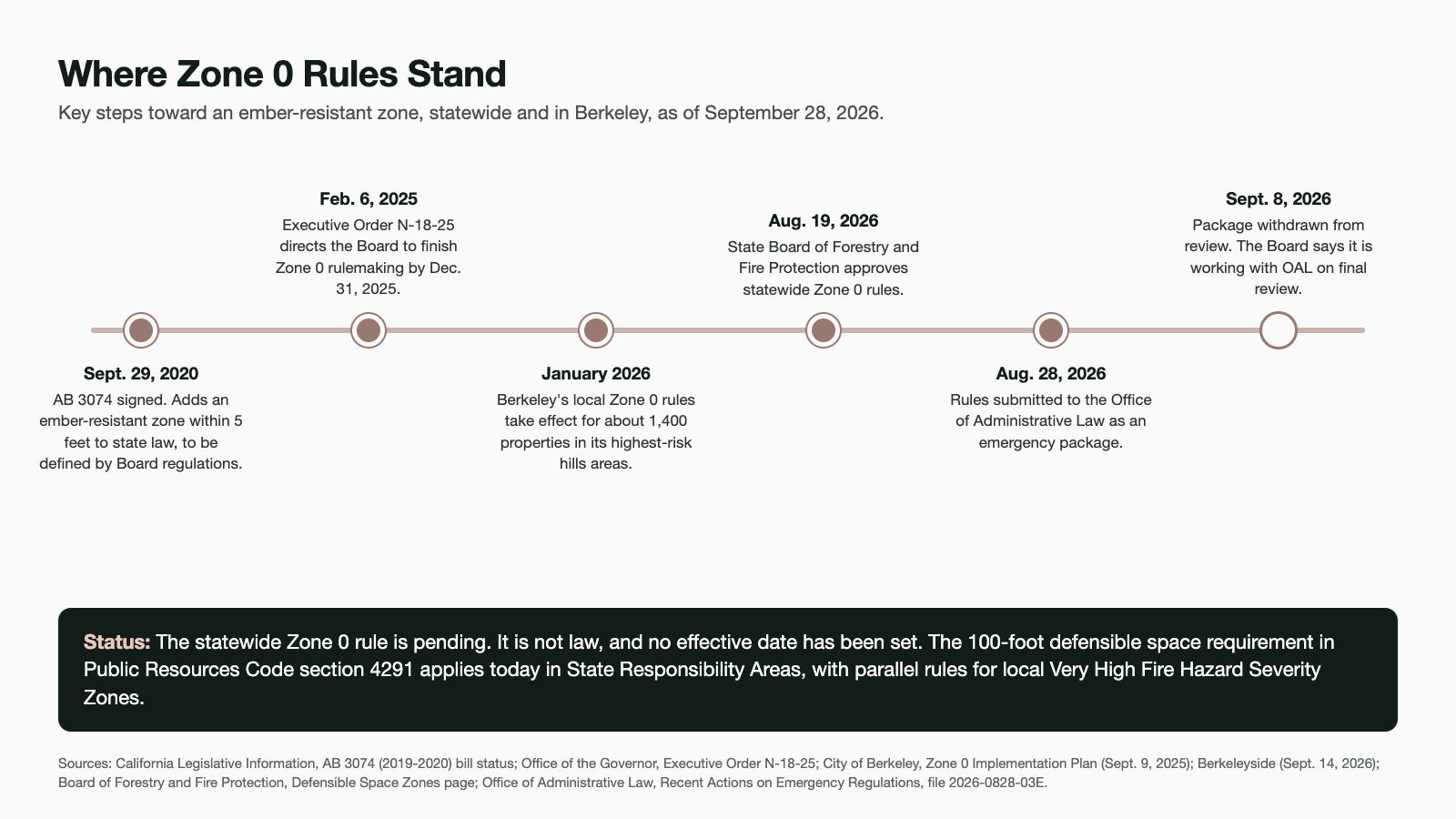
Berkeley adopted its own Zone 0 rules through its EMBER initiative, which the City Council approved on June 17, 2025, according to the city's implementation plan. The rules cover just under 1,400 properties in the Grizzly Peak and Panoramic Hill areas, the city's highest-risk fire zones. Berkeleyside reports the rules took effect in January 2026, and the Berkeley Fire Department planned to begin enforcement inspections this year. In those areas, almost nothing that can burn may sit within five feet of a home, with limited exceptions for small potted plants and well-maintained mature trees.
Statewide: AB 3074 and the Board of Forestry
AB 3074, signed in 2020, added the ember-resistant zone to state law and left the details to the Board of Forestry and Fire Protection. In February 2025, Governor Newsom's Executive Order N-18-25 directed the Board to speed up that work and finish rulemaking by December 31, 2025. That deadline passed.
The Board approved statewide Zone 0 rules on August 19, 2026, and submitted them to the Office of Administrative Law as an emergency package on August 28. The Office of Administrative Law lists that package as withdrawn on September 8, 2026, and the Board says it is working with the office on final review. As of September 28, 2026, the statewide Zone 0 rule is proposed and pending. It is not law, and it has no effective date. Under the Board's proposal, the rules would apply to new construction first and phase in for existing homes over several years.
How a Walkaround Video Fits
An assessment built on your answers alone tops out at 90. After you see your score, the report invites you to upload one walkaround video of up to 20 seconds showing a complete loop of the property. The last ten points come from a verified walkaround.
Uploading earns no points by itself. The review can confirm or correct an answer, and if it corrects one, your score is recalculated from the corrected answers using the same methodology, so it can move in either direction. Every correction is shown to you with a way to dispute it. GPS coordinates are stripped from anything you upload. Individual photo uploads are not part of the live assessment today; the walkaround video is how you add evidence.
What Your Score Means
Your result has four parts: a score from 5 to 100, a range around it that shows how much the number could move once more of the property is seen, an evidence tier recording what the score is based on, and a label such as "Substantially defended" or "Well defended." You can see how it all fits together in the sample report.
The report then lists your next steps, ranked by the fastest protection per dollar, with each step marked as lower, mid or higher cost. Those cost bands are planning ranges, not quotes.
Keep in mind what the score is. It is a readiness measure for the ground around your home. It does not guarantee that a home will survive a wildfire, and it does not promise any insurance outcome or discount. It also does not score the building itself. For the roof, vents, windows and walls, use the free Home Hardening Score. For a household checklist and evacuation plan, try Wildfire Action Plan.
What We Are Building Toward
Our goal at Loss Prevention Solutions is to gather the evidence that shows insurance carriers that mitigation lowers wildfire risk, and to make the case that lower risk should mean better insurability and lower premiums. We are working toward that goal; we have not proven it yet.
What exists today is a California regulation. Under the Department of Insurance's Safer from Wildfires framework, codified at 10 CCR 2644.9, insurers are required to recognize qualifying wildfire mitigation measures. What that means for your policy depends on your carrier, so ask them directly.
Get Started
See where your yard stands and what to work on first. It takes about five minutes, and it is free.
California homeowners: check your coverage with Five Bays Insurance Agency and see how mitigation may affect your insurability. Five Bays is a licensed California insurance agency (CDI license 6016871) owned by AACI Group, which also operates Defensible Space Score, and it may earn a commission on any policy placed.
Sources
- Public Resources Code Section 4291, California Legislative Information, as amended effective October 13, 2025.
- AB 3074 (2019-2020), Fire Prevention: Wildfire Risk: Defensible Space: Ember-Resistant Zones, California Legislative Information, chaptered September 29, 2020.
- Governor Newsom Signs Executive Order to Further Prepare for Future Urban Firestorms (Executive Order N-18-25), Office of the Governor of California, February 6, 2025.
- Defensible Space Zones 0, 1, and 2, California Board of Forestry and Fire Protection, accessed September 28, 2026.
- Recent Actions on Emergency Regulations (file 2026-0828-03E, Zone 0 Defensible Space), California Office of Administrative Law, accessed September 28, 2026.
- Fire Hazard Severity Zone 0 Implementation Plan, City of Berkeley, September 9, 2025.
- "Zone Zero" Rules May Soon Affect Hundreds More Berkeley Homes, Berkeleyside, September 14, 2026.
- Defensible Space, CAL FIRE Ready for Wildfire, accessed September 28, 2026.
- Preparing Homes for Wildfire, National Fire Protection Association, accessed September 28, 2026.
- Safer from Wildfires, California Department of Insurance, accessed September 28, 2026.
- 10 CCR 2644.9, Consideration of Mitigation Factors; Wildfire Risk Models, California Code of Regulations (via Cornell Legal Information Institute), operative October 14, 2022.