Zone 0
Zone 0 Went Back to the Board in November: Where It Stands
The statewide Zone 0 rule was back in front of the Board of Forestry and Fire Protection on November 5, 2026. On November 16, 2026, a Board of Forestry Zone 0 filing appeared on the Office of Administrative Law's list of emergency regulations under review. As of November 17, 2026, it is still not in effect.
The 100-foot defensible space law is in force today, and two California cities already have their own rules for the first five feet. You do not need to wait for a statewide date to look at the area around your walls, here are the most important thing you can do to minimize your Zone 0 threat.
Where is Zone 0 Legislation Now?
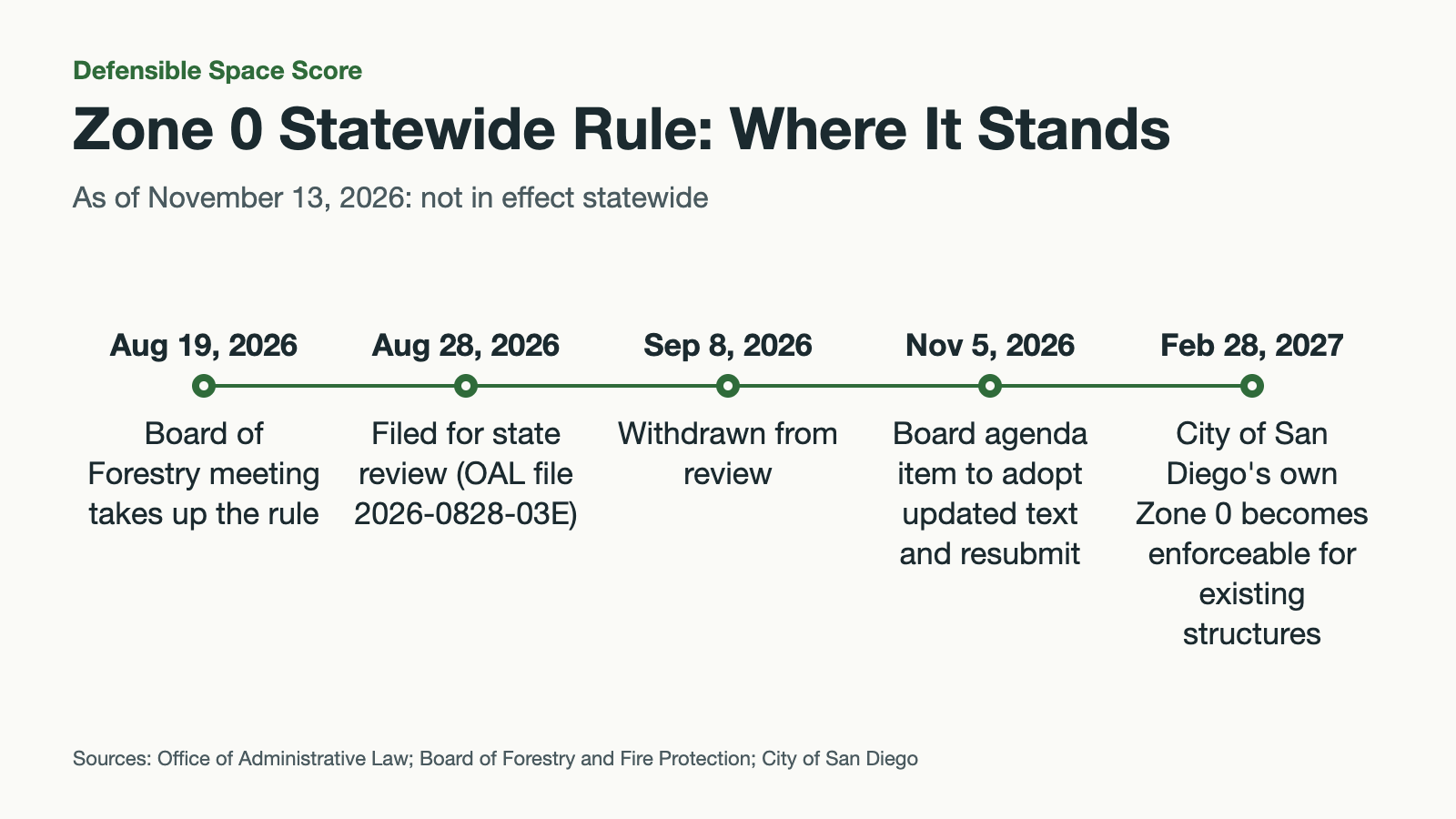
The Board approved a Zone 0 rule in August 2026, withdrew it from state review on September 8, and took it up again on November 5 for resubmission. On November 16, the Office of Administrative Law's list showed a new Board filing under review. As of November 17, 2026, it is not in effect statewide.
- August 19, 2026: the Board took up the rule at its meeting. A decision memo is listed on the Board's Zone 0 page.
- August 28, 2026: the package was filed with the Office of Administrative Law (OAL) as emergency file 2026-0828-03E, a date taken from the file number. OAL's list of recent actions shows it as Withdrawn on September 8, 2026.
- November 5, 2026: the Board's agenda carried item 13a, "Consider adopting the updated Finding of Emergency and final rule text for submission to the Office of Administrative Law".
- As of November 17, 2026: OAL's list of emergency regulations under review shows a Board of Forestry filing titled "Defensible Space Zone 0", file number 2026-1116-02E, dated November 16, 2026. OAL's list of recent actions shows no action on it yet, and no effective date exists.
The 100-foot law is separate and in force. Section 4291 of the Public Resources Code requires defensible space within 100 feet of a structure (or to the property line), with more intense fuel reduction between 5 and 30 feet. It also calls for "an ember-resistant zone being required within 5 feet of the structure, based on regulations promulgated by the board". Under subdivision (g), that requirement does not take effect for new structures until the Board updates its regulations, and for existing structures it follows three years after the date for new structures.
Two cities have moved on their own. The City of San Diego's Zone 0 Guidelines for Existing Structures, revised April 22, 2026, say Zone 0 for existing structures is "not enforceable until February 28, 2027", with full compliance by February 28, 2029. They add that the date can change at the Fire Code Official's discretion. In Berkeley, a council item dated November 10, 2025 states the Council adopted Zone 0 into the city's Fire Code on June 17, 2025, with stricter requirements in the Grizzly Peak and Panoramic Mitigation Areas effective January 1, 2026.
The California Department of Insurance lists a 5-foot ember-resistant zone among the measures in its Safer from Wildfires FAQ (September 2026). California requires insurers to offer discounts for these measures. The regulation sets no amount.
Zone 0 in the Defensible Space Score: Your First Five Feet
The Defensible Space Score asks about Zone 0, the area 0 to 5 feet from your building, and whether vegetation touches structures. The score runs from 0 to 100 with next steps and covers the whole 100 feet (how the tool works).
Walk around your home with a bag and a rake. Look for:
- Dead leaves and needles against the wall, in corners and at the base of steps.
- Stored items, such as firewood, boxes, furniture and trash bins.
- Anything touching the siding, such as shrubs, vines, wood stacks and trellises.
- Debris around and under decks. Our post on decks, fences and attachments explains why.
If a job is bigger than you want to handle, WildfireList is a free directory of wildfire mitigation providers in California.
Zone 1 runs from 5 to 30 feet and Zone 2 from 30 to 100 feet. Our defensible space guide covers both.
What This Does Not Mean
The Defensible Space Score is a self-check, not an inspection, and it never determines legal compliance. This post does not say what the pending Zone 0 rule will require, and no effective date exists. Nothing here predicts what any insurer will offer you, so ask your own agent or insurer. A clear first five feet lowers the chance embers find something to burn, and it guarantees nothing.
Where to Go Next
Get your free Defensible Space Score, or update it if you have done work since your last one.
Sources
- California Public Resources Code section 4291, as of November 13, 2026
- Board of Forestry Zone 0 page, as of November 13, 2026
- OAL recent actions on emergency regulations, as of November 17, 2026
- Board of Forestry November 2026 agenda, November 5, 2026
- OAL emergency regulations under review, as of November 17, 2026
- City of San Diego Zone 0 Guidelines, revised April 22, 2026
- City of Berkeley council item, November 10, 2025
- California Department of Insurance Safer from Wildfires FAQ, September 2026
- WildfireList, as of November 13, 2026